

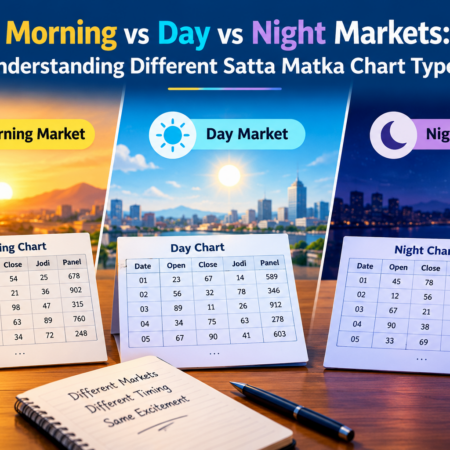
Morning, day, and night markets are generally categorized according to their scheduled market periods. Although their charts may look similar, each market can have its own name, schedule, and historical records. Understanding these differences can help readers correctly navigate a morning satta matka market chart, day satta matka market chart, or night satta matka market chart without mixing information from different markets.
Charts are mainly used to organize previously published market information in an easy-to-read format. Depending on the website, they may include dates, market names, Open and Close results, Jodi, Panel or Panna details, and previous records.
The most important thing to remember is that morning, day, and night refer to the market period, while a chart refers to the way market information is organized and displayed.

What Are Morning, Day, and Night Satta Matka Markets?
Morning, day, and night markets are broad time-based categories used to organize different Satta Matka markets and their published results. The exact market names and operating schedules can vary from one market or information source to another.
A typical chart may contain:
- Market name
- Date
- Open result
- Close result
- Jodi information
- Panel or Panna information
- Previous results
- Historical market records
Because different websites can use different formats, readers should always check the market heading, date, and labels shown on the page.
A simple way to understand this is to think of morning, day, and night as different categories, while the chart acts as a record that organizes information within each category.
How Does a Morning Satta Matka Market Chart Work?
A morning satta matka market chart organizes historical information related to markets scheduled during the morning period. Readers can use such charts to locate previous dates, market names, and available result information.
For example, a morning chart may include:
- Date-wise historical records
- Open and Close information
- Jodi records
- Panel or Panna details
- Previous market results
The exact design depends on the website. Some charts display information in rows and columns, while others divide Open, Close, Jodi, and Panel information into separate sections.
What Is a Satta Matka Morning Chart Guide Useful For?
A satta matka morning chart guide can help beginners understand how morning-market records are structured and how to locate specific information.
When reading a morning chart, start by identifying:
- The correct market name.
- The date of the record.
- The type of result information displayed.
- Open or Close details, if available.
- Jodi and Panel/Panna information, where provided.
Historical charts should be viewed as records of previous information. Past results do not guarantee or determine future outcomes.
How Does a Day Satta Matka Market Chart Differ?
A day satta matka market chart contains historical information for markets that fall within the daytime category. Its overall structure may be similar to a morning chart, but the market and scheduled period can be different.
Depending on the source, a day chart may include:
- Market name
- Date
- Open result
- Close result
- Jodi
- Panel or Panna
- Historical results
One common mistake is assuming that two charts are interchangeable simply because they have a similar layout. The appearance of a chart only explains how information is presented. It does not mean that records from one market belong to another.
How Should You Read a Satta Matka Day Chart Guide?
A satta matka day chart guide should primarily help readers understand the information displayed on a chart.
A simple reading process is:
- Select the correct day market.
- Verify the date.
- Identify the result categories.
- Read the appropriate row or column.
- Use previous records only as historical information.
- Avoid treating historical patterns as guaranteed predictions.
Taking these steps can make large historical charts easier to understand and navigate.
What Is a Night Satta Matka Market Chart?
A night satta matka market chart organizes historical records associated with markets scheduled during the night period.
Like morning and day charts, a night chart can display date-wise records and different result categories. However, the specific information available depends on the website and the market being referenced.
Before reading a night chart, check:
- Exact market name
- Date
- Displayed result
- Open or Close status
- Jodi information
- Panel or Panna details
- Whether the information is historical or current
This helps prevent confusion when several market pages have similar-looking tables.
What Are the Different Satta Matka Chart Types?
The different Satta Matka chart types generally refer to the way market and result information is organized. A website may provide separate pages for market results, Jodi records, Panel/Panna records, or historical data.
| Chart Type | General Information |
|---|---|
| Market Result Chart | Results organized according to market and date |
| Jodi Chart | Two-digit Jodi records |
| Panel/Panna Chart | Three-digit Panel or Panna information |
| Historical Chart | Previous records arranged by date |
| Morning Chart | Records associated with a morning market |
| Day Chart | Records associated with a daytime market |
| Night Chart | Records associated with a night market |
The terminology and presentation can vary between websites. Therefore, readers should follow the labels and explanations provided by the particular source they are using.
How Are Morning, Day, and Night Satta Matka Charts Different?
Morning day night Satta Matka charts can have similar layouts, but the primary difference is the market period they represent.
| Feature | Morning | Day | Night |
|---|---|---|---|
| Time Category | Morning | Daytime | Night |
| Main Purpose | Organizes morning-market records | Organizes daytime records | Organizes night-market records |
| Historical Data | May be available | May be available | May be available |
| Jodi Information | Depends on source | Depends on source | Depends on source |
| Panel/Panna | Depends on source | Depends on source | Depends on source |
| Schedule | Varies by market | Varies by market | Varies by market |
The schedule should always be verified because there is no single universal timetable that necessarily applies to every market or website.
Why Should Morning, Day, and Night Charts Be Kept Separate?
Keeping market charts separate makes it easier to identify the correct records and avoid mixing information.
For example, a morning market chart and a night market chart may use almost identical table structures. However, their market names, dates, and records can be completely different.
Separating the charts can help with:
- Finding the correct historical record
- Checking dates accurately
- Identifying market-specific information
- Avoiding accidental mixing of results
- Navigating large amounts of historical data
- Understanding different market categories
For an informational website such as SattaMatkaHub, clearly organized market categories can also make navigation easier for readers looking for a particular market or historical chart.
Can Historical Satta Matka Charts Predict Future Results?
No. A historical chart only records information about previous outcomes. It cannot establish a reliable or guaranteed method for determining a future result.
Historical charts can sometimes appear to contain repeated numbers or noticeable sequences. However, identifying a pattern in previous records does not mean that the same pattern will continue.
For this reason, historical information should be presented as past data and reference material, rather than as a prediction, guarantee, or winning formula.
How Can Beginners Read Satta Matka Charts More Carefully?
Beginners can make charts easier to understand by focusing on the market name, date, and result labels before looking at individual records.
Step 1: Identify the Market
First, confirm whether you are viewing a morning, day, or night market and check the exact market name.
Step 2: Check the Date
Always verify the date associated with the record. Do not assume that the first row automatically represents the latest information.
Step 3: Understand the Columns
Look for labels such as Open, Close, Jodi, Panel, or Panna. Understanding these labels helps you interpret the information correctly.
Step 4: Separate Current and Historical Information
A historical chart and a current-result page may serve different purposes. Make sure you understand which type of information you are viewing.
Step 5: Cross-Check Unclear Information
If information appears inconsistent, check the market heading, date, update information, and source rather than making assumptions.
Step 6: Treat Historical Records as Historical Data
Previous records explain what was published in the past. They should not be treated as a guarantee of what will happen in the future.
What Should You Check Before Using a Satta Matka Chart?
Before using any chart as an informational reference, verify that the page clearly identifies the market and date.
A useful checklist includes:
- Correct market name
- Correct market period
- Correct date
- Clearly labeled result fields
- Historical or current status
- Consistent chart formatting
- Latest update information, where applicable
This becomes especially important when a website contains multiple market pages with similar layouts and names.
Frequently Asked Questions
What Is the Difference Between Morning, Day, and Night Markets?
The primary difference is the scheduled market period. Morning markets belong to the morning category, day markets to the daytime category, and night markets to the night category. Exact schedules can vary depending on the individual market and information source.
What Does a Satta Matka Chart Show?
A Satta Matka chart generally organizes market information according to dates and result categories. Depending on the website, it may contain Open, Close, Jodi, Panel/Panna, and previous-result information.
Are Morning, Day, and Night Charts the Same?
They can have similar layouts, but they may represent different markets and time periods. Always verify the market name and date before interpreting the information.
Can Previous Chart Results Predict the Next Result?
No. Previous results are historical records and cannot provide a guaranteed method for predicting a future result.
How Can Beginners Read a Satta Matka Chart?
Beginners should start by identifying the market, confirming the date, understanding the chart labels, and distinguishing historical information from current updates. Charts are best understood as informational records rather than guarantees of future outcomes.
Practical Takeaway
When comparing morning vs day vs night Satta Matka markets, the first priority should be identifying the correct market, period, and date.
Morning, day, and night charts may look similar, but their records should not automatically be treated as interchangeable. Understanding the chart structure and checking the relevant market details can make historical information easier to navigate.
Use charts as a way to understand and review published historical data, and avoid treating previous results as a guarantee or prediction of future outcomes.

Other Articles

Understanding Madhuri Chart Numbers: Meaning, History & How to Check Results
Charts Padmavati Satta Matka Results: Chart History, Jodi and Panel Records

No Comment! Be the first one.